
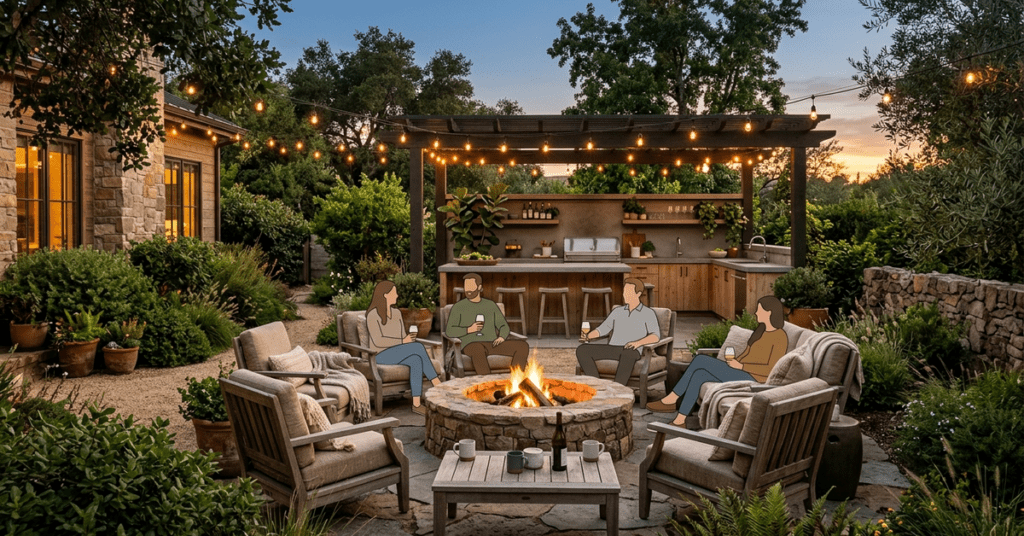
There’s a pattern that shows up often with homeowners who put in a patio or pergola or screened porch. They describe using their backyard in a way that sounds almost surprised — like they’re discovering a part of their property they didn’t realize they had. Three or four evenings a week outside instead of zero. Dinner out there on a weeknight because it’s easy, not because they planned for it. Kids doing homework in the afternoon because there’s a shaded, comfortable spot.
None of this happens by accident. It happens because the space became usable in a practical way — because there’s shade, or comfort, or definition — and the default changed from staying inside to going out.
The Comfort Problem
The main reason most backyards go unused isn’t aesthetics. It’s comfort. Augusta gets genuinely hot, and heat on an unshaded concrete or grass surface in June or July is not something most people opt into voluntarily. The bugs are real from spring through fall. And most unimproved outdoor spaces don’t have anywhere to actually sit that feels settled and comfortable — you drag out chairs, the surface is uneven or hard, there’s no table, and the whole experience requires effort.
Solving the comfort problem is the central project of a good outdoor living space. Shade from a pergola or porch roof cuts the direct-sun factor. Screening addresses the insects. A good patio surface gives you a stable, level place to put furniture that doesn’t sink or shift. Once those three things are in place, being outside requires about as much effort as being in any other room of your house.
This matters more than any particular aesthetic choice. A very simple pergola over a plain concrete patio that solves the shade and definition problem will get used more than an elaborate outdoor kitchen setup that still leaves you sitting in full afternoon sun.
The Definition Problem
Beyond comfort, there’s a definition problem. Open yard space doesn’t invite you to do anything. There’s no visual cue about where to sit, or what kind of activity happens there, or where the outdoor space ends. A pergola or covered patio creates a room. It has edges. It has a ceiling of sorts. It signals that this is a place where something happens, and your brain responds to that by wanting to be there.
The furniture arrangement matters here too. Outdoor furniture that’s scattered across a patio in no particular configuration doesn’t create the same sense as furniture that’s arranged around a defined gathering point — a table, a fire pit, a coffee table between a couple of chairs. The arrangement implies what the space is for, and that changes how you use it.
You don’t need to spend a lot of money on the furniture to get this effect. An arrangement that makes sense for the way you actually live — maybe just a table and six chairs under a pergola — is more valuable than expensive furniture with no organizing logic.
What the CSRA Climate Makes Possible
One thing worth noting is how much outdoor living is actually available here. Augusta has serious summer heat, but spring and fall are genuinely good, and winter is mild enough for outdoor use on most days. In practical terms, that’s eight or nine months where your outdoor space is comfortable for at least part of the day. That’s a significant amount of usable space if the space is set up to take advantage of it.
A screened porch pushes the usable window further by keeping you comfortable in the summer months when mosquitoes and heat are at their worst. A pergola with a ceiling fan does the same for shaded, open-air situations. A fire pit or patio heater extends the comfortable range in both directions — fall evenings when the temperature drops and winter afternoons when it’s mild but not quite warm.
None of these are complicated additions. The common thread is that each one removes a specific barrier to using the space.
Starting the Right Way
If you’re thinking about investing in your outdoor space, the most useful thing you can do before making any specific decisions is to spend a couple of weeks paying attention to when you actually go outside and what stops you from going outside more. The answer to that second question almost always points directly to the right project.
People who don’t go outside because it’s too hot need shade. People who don’t go outside because of bugs need screening. People who have a concrete slab they never use because it’s uncomfortable and undefined need a pergola or cover and some intentional furniture arrangement. The right project is the one that actually solves your specific problem, and that’s almost always the one you’ll use.