
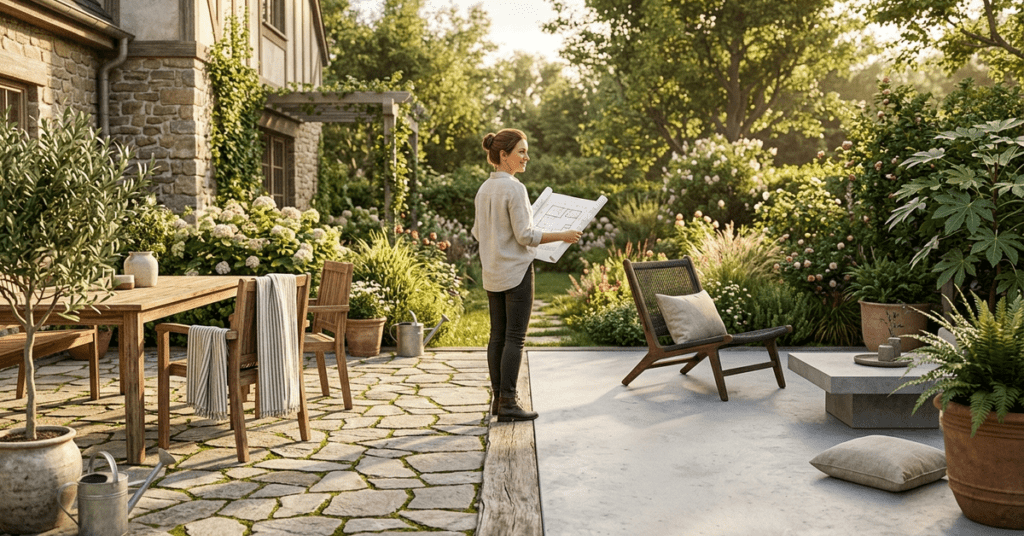
The most common question when someone decides to put in a patio is which material to use, and the honest answer is that it depends on what you care about most. Cost, appearance, durability, and maintenance all pull in different directions depending on which option you choose, and Augusta’s climate adds a few specific considerations that matter here more than in other parts of the country.
Here’s what the main options actually look like in practice.
Poured Concrete: The Honest Picture
Concrete is the most affordable option per square foot, and for straightforward patio applications it’s perfectly functional. A basic broom-finished concrete slab is durable, low-maintenance, and holds up well over time. If you’re covering a large area and budget is the primary concern, concrete is a reasonable choice.
The issue in Augusta is the heat. Unsealed concrete in direct sun gets hot — genuinely hot, not just warm — in ways that limit how comfortable it is to use on summer afternoons. That’s solvable with a patio cover or pergola overhead, but it’s a real factor. Concrete also cracks over time, and while hairline cracks are mostly cosmetic, larger cracks aren’t easily repaired invisibly and tend to grow if water gets in and the soil beneath shifts.
Stamped or stained concrete is a middle ground. It’s more expensive than a basic slab and gives you more visual interest, but it carries the same structural issues and adds a surface coating that can chip or fade and require maintenance to look right over time.
Pavers: Why They’re Worth Considering
Concrete pavers cost more upfront than a poured slab, and they’re worth the conversation anyway. The biggest practical advantage is repairability. If a section settles, cracks, or gets stained badly, you pull those pavers, re-level the base, and reset them. You can’t do that with poured concrete. A poured slab that settles and cracks is a problem. A paver patio that settles and cracks is an afternoon.
Pavers also stay cooler than concrete under the same sun conditions. The texture and the joints between units reduce heat retention, and many modern paver products have light-reflective surfaces that make a meaningful difference in surface temperature.
In terms of appearance, pavers give you more flexibility than concrete. Sizes, colors, patterns, and borders can be combined in ways that make a patio feel more designed and intentional. This matters more when the patio is visible from inside the house or from the street.
The downside is weeds in the joints, which is a real thing. Polymeric sand — the kind contractors use between pavers that hardens slightly and resists weed growth — handles most of this, but it’s not a forever solution. You’ll typically add some more polymeric sand every few years and pull occasional weeds. It’s a manageable maintenance task, not a constant chore.
Natural Stone: The Premium Option
Flagstone, travertine, and other natural stone options look great and hold their value well. They’re also significantly more expensive than concrete or concrete pavers, and natural stone surfaces tend to be irregular, which means you need to think carefully about furniture placement and whether you’re okay with some variation in level underfoot.
Travertine is worth mentioning specifically because it’s popular in warmer climates. It’s naturally porous, which means it stays cooler underfoot than concrete or some pavers, but it also requires sealing and can stain if you’re not attentive to spills. For families with kids or anyone who uses the patio as a food and entertaining space, that’s a real consideration.
What Matters Most in the CSRA
A few things are specific to this region. First, the soil in a lot of Augusta and the surrounding area shifts with moisture and heat — proper base preparation is essential regardless of which surface you choose. A patio that fails in year two because the base wasn’t prepared correctly is not a materials problem, it’s a shortcuts problem. Second, drainage matters a lot. Augusta gets real rain, and a patio that doesn’t slope properly to drain away from the house will have water management problems. Both of these are reasons to work with someone who has installed enough patios in this area to know the local conditions.
The right material is the one that matches what you actually want: how much you want to spend, how much maintenance you’re comfortable with, and how much you care about the appearance relative to the cost. Those are real tradeoffs, and it’s worth being clear about your priorities before you commit.