
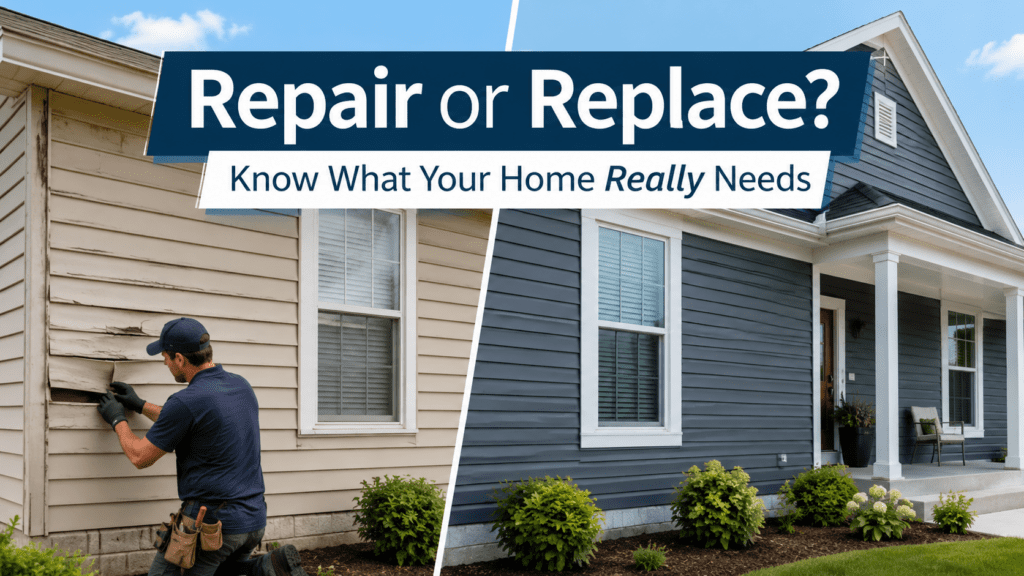
How to Know Which One Your Home Really Needs
Siding problems love to start small.
One cracked panel. One warped spot. One area that looks a little faded. One soft section you keep meaning to check “later.”
Then later turns into a bigger problem.
Here’s the tabloid truth: damaged siding is not just an ugly exterior issue. It can be your home’s warning sign that moisture, pests, or age are starting to win.
For homeowners in Augusta and the CSRA, siding takes a beating from heat, humidity, storms, pollen, and everyday wear. So when damage shows up, the big question becomes: should you repair the siding, or is it time to replace it?
Let’s break it down in plain language.
First, what does siding actually protect?
Siding is not just there to make your home look nice. It helps protect the exterior walls from rain, wind, pests, and moisture.
When siding is working correctly, it helps keep water out and gives your home a cleaner, more finished appearance.
When siding starts failing, problems can move beyond curb appeal. Moisture can get behind damaged areas and affect the materials underneath. That is why many siding pros warn that moisture-related siding issues can eventually lead to wood rot, mold growth inside wall cavities, insulation problems, pest attraction, and more expensive repairs if ignored.
That does not mean every crack is a disaster. But it does mean siding damage is worth taking seriously.
When siding repair makes sense
Siding repair is often the right choice when the problem is small, isolated, and not part of a bigger pattern.
A repair may make sense if:
- One or two panels are cracked
- A small section was damaged by a storm or impact
- A few pieces are loose
- The rest of the siding is still in good shape
- There are no signs of moisture damage behind it
- The siding color and style can be matched closely enough
For example, if a branch hit one section during a storm, replacing that damaged section may be all you need.
Repair is also a good option when the siding system is still structurally sound. Industry guidance generally points to repair when damage is isolated, such as cracked or loose panels, minor storm damage, small areas of rot, or limited warping.
When siding replacement is the smarter move
Replacement becomes the better choice when the damage is widespread, recurring, or connected to deeper issues.
You may need siding replacement if you notice:
- Large areas of warping
- Multiple cracked or broken panels
- Soft spots or rot
- Moisture stains inside or outside
- Mold or mildew that keeps coming back
- Siding pulling away from the home
- Major fading across the whole exterior
- Repeated repairs that do not last
This is where homeowners can accidentally waste money. If you keep repairing one section after another, you may be paying for a slow replacement one patch at a time.
The moisture question: what is hiding underneath?
This is the part homeowners cannot always see from the yard.
If water has reached the sheathing, insulation, or framing behind the siding, a simple surface repair may not be enough. Once moisture moves beyond the siding panels, the underlying materials may need to be addressed before new siding goes on. In that situation, the project starts looking more like replacement than a quick patch.
Possible warning signs include:
- Peeling paint on interior walls near exterior-facing areas
- Bubbling wallpaper
- Musty smells
- Soft trim or fascia nearby
- Staining around windows or doors
If the siding looks bad outside and something feels off inside, do not ignore it.
The age factor: how old is your siding?
Age matters.
Even good siding does not last forever. Vinyl siding can often last decades, but age, sun exposure, storms, installation quality, and maintenance all affect its lifespan. Home improvement sources commonly note vinyl siding may last around 30 to 40 years, with longer performance possible when it is well maintained.
If your siding is fairly new and only has one damaged area, repair may be reasonable.
If your siding is older and damage is showing up in multiple areas, replacement may be the better long-term investment.
Color matching can be harder than homeowners expect
This is a sneaky issue.
Even if you find the same siding product, the new piece may not match perfectly because the existing siding has faded from years of sun exposure.
That does not always matter if the repair is on a less visible side of the home. But if the damaged area is right on the front, a patch can stand out.
So the question becomes:
Would you rather have one mismatched repair, or a refreshed exterior that looks consistent?
There is no one right answer. It depends on the location, your budget, and your long-term plans for the home.
Repair vs replacement: the homeowner decision guide
Here is a simple way to think about it.
Repair may be best if:
- Damage is limited to one area
- The siding is still fairly new
- The material can be matched
- There are no moisture problems underneath
- The rest of the exterior looks good
- You need a budget-friendly fix
Replacement may be best if:
- Damage appears in several areas
- The siding is old or brittle
- Repairs keep coming back
- Moisture has gotten behind the siding
- The color is badly faded
- You want better curb appeal and long-term protection
The “do not wait” signs
Some siding issues should be checked sooner rather than later.
Call for an inspection if you notice:
- Siding that feels soft when pressed
- Panels pulling away from the home
- Water stains near windows, doors, or trim
- Warping that spreads
- Interior moisture signs
- Mold or mildew that returns after cleaning
These are the signs that siding may not just be damaged. It may be failing.
Why this matters for Augusta and CSRA homes
Our area is not gentle on exteriors.
Between hot summers, humidity, heavy rains, storm debris, and pollen buildup, siding has to work hard. Small gaps or cracks can let moisture in, and moisture is one of the biggest reasons siding problems get expensive.
That is why it is smart to catch issues early and decide whether repair or replacement makes more sense before the damage spreads.
Bottom line
Siding repair is a smart choice when the damage is small, isolated, and the rest of your siding is still in good shape.
Siding replacement is the better choice when the damage is widespread, recurring, moisture-related, or making the home look tired and unprotected.
The goal is not to spend more than you need to. The goal is to protect your home before a small exterior issue becomes a bigger wall, moisture, or curb appeal problem.
If you are not sure which direction makes sense, a professional siding estimate can help you compare repair needs, replacement options, and what will give your home the best long-term result.
K&K Exteriors: Explore Siding Installation & Exterior Remodeling in Augusta
Contact K&K Exteriors: Schedule Your Siding Estimate: Get a Siding Estimate in Augusta