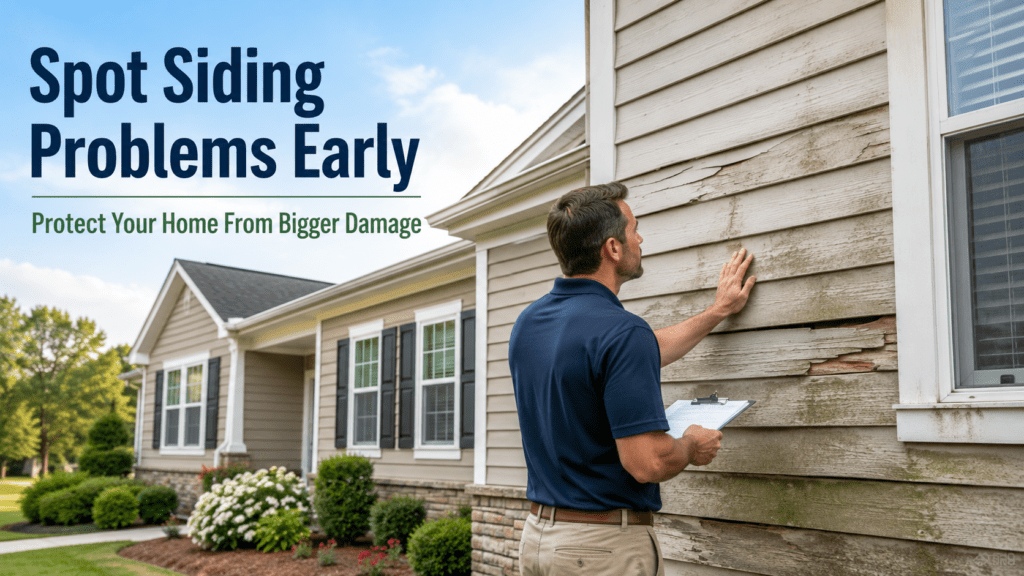
Warning Signs Homeowners Shouldn’t Ignore
Your siding can be sneaky.
It may not fall off the house. It may not scream for attention. It may not look like a disaster from the driveway.
But small siding problems can quietly turn into bigger exterior problems if water, pests, or age start getting behind the surface.
Here’s the tabloid truth: your siding may be failing long before your home looks “bad.” A few cracks, warped panels, or soft spots can be your home’s way of saying, “Please deal with this before it gets expensive.”
For homeowners in Augusta and the CSRA, siding works hard against heat, humidity, heavy rain, wind, pollen, and storm debris. That means it is worth knowing the warning signs early.
Why siding problems matter
Siding is not just decoration. It helps protect your home’s exterior walls from weather and moisture.
When siding starts failing, the problem can move past curb appeal. Common warning signs that siding may need replacement include cracking, rotting, bubbling paint, mold growth, major fading, frequent repairs, and even sudden energy bill changes. Failing siding can also create risk for water damage and mold if it is ignored.
That does not mean every faded panel means panic. But it does mean siding problems deserve a closer look.
Warning sign #1: Cracks, holes, or broken pieces
Cracks and holes are some of the clearest signs your siding needs attention.
Small damage can happen from:
- Storm debris
- Lawn equipment
- Heat and age
- Impact from branches
- General wear over time
One small crack may be repairable. But if you see cracks across several areas, the siding may be getting brittle or worn out.
The bigger issue is what cracks can allow in: moisture and pests.
If water gets behind the siding, the damage can spread to materials underneath. That is when a simple siding issue can turn into a bigger exterior repair.
Warning sign #2: Warping or buckling
Warped siding is siding that no longer sits flat against the home.
It may look like:
- Wavy panels
- Bulging sections
- Siding that looks melted or distorted
- Areas that pull away from the wall
Warping can happen from heat, improper installation, trapped moisture, or age. InspectAPedia notes that vinyl siding can buckle if it is improperly installed, such as being nailed too tightly, because siding needs room to move with temperature changes.
If your siding looks uneven in multiple areas, it is worth having it checked.
Warning sign #3: Siding pulling away from the house
Siding should sit securely on the home.
If panels are loose, separating, or pulling away, that can create gaps where water and insects may enter.
Watch for:
- Gaps between panels
- Loose edges
- Panels rattling in wind
- Sections that look like they are lifting
This can happen after storms, poor installation, or years of movement. Either way, loose siding should not be ignored.
Warning sign #4: Soft spots or rot nearby
Vinyl siding itself does not rot, but the materials behind it can. Wood siding and trim can also develop rot when moisture gets involved.
Check around:
- Windows
- Doors
- Corners
- Trim boards
- Areas near gutters or rooflines
If trim feels soft, spongy, or crumbles when touched, moisture may already be part of the problem.
This is especially important in humid areas like the CSRA, where moisture can linger and make exterior problems worse.
Warning sign #5: Mold, mildew, or algae that keeps coming back
A little outdoor grime is normal. But if mold, mildew, or algae keeps returning in the same area, that can be a clue something is staying damp.
Pay attention if growth appears:
- Near seams
- Around windows
- Under roof overhangs
- Near gutters or downspouts
- In shaded areas that never fully dry
Sometimes this is just a cleaning issue. Other times, it points to poor drainage, trapped moisture, or siding that is no longer protecting the wall correctly.
Warning sign #6: Fading that looks extreme
All siding fades over time, especially under strong sun. But major fading can mean the material is aging and losing its original protective finish.
If one side of the house looks dramatically more faded, chalky, or worn than the rest, it may be time to discuss replacement options.
Fading alone may not always be urgent. But fading combined with cracks, brittleness, warping, or repeated repairs is a bigger warning sign.
Warning sign #7: Higher energy bills or rooms that feel less comfortable
This one surprises homeowners.
Siding is not your only insulation barrier, but failing siding can contribute to comfort problems if gaps, damage, or moisture issues affect the home’s exterior envelope.
If certain rooms feel hotter, colder, draftier, or more humid than usual, and your siding is also showing signs of age, it may be connected.
Bob Vila lists a sudden increase in energy bills as one possible sign that siding may need replacement, especially when paired with other issues.
Warning sign #8: Interior paint or wallpaper problems near exterior walls
Sometimes siding failure shows up inside first.
Look for:
- Peeling paint
- Bubbling wallpaper
- Water stains
- Musty smells
- Damp-feeling walls near exterior sides of the home
These signs can point to moisture getting where it should not be. If the outside siding is also cracked, warped, or loose, it is time to investigate.
Warning sign #9: You keep paying for repairs
Repairs are useful when the problem is small.
But if you are fixing one panel this month and another section next month, your siding may be telling you it is near the end of its useful life.
At some point, repeated repairs become a slow-motion replacement.
Ask yourself:
- Are the same areas failing again?
- Are new problems showing up after every storm?
- Is matching the color becoming impossible?
- Does the exterior still look tired after repairs?
If yes, replacement may make more sense than another patch.
Warning sign #10: Your siding is old and showing several symptoms at once
Age matters.
Vinyl siding can commonly last around 30 to 40 years, and sometimes longer with proper maintenance, but lifespan depends on material quality, installation, climate, and upkeep. Signs that replacement may be needed include rot, holes, fading, warped or broken boards, and increased utility bills.
If your siding is older and showing multiple warning signs, it may be time to think beyond repairs.
The CSRA homeowner reality
In Augusta and the CSRA, siding deals with a lot:
- Hot sun
- Heavy humidity
- Sudden storms
- Wind-blown debris
- Pollen buildup
- Moisture around shaded areas
That combination can make small siding problems spread faster than homeowners expect.
The sooner you catch siding issues, the easier it is to decide whether repair or replacement is the right move.
Quick homeowner checklist
Walk around your house and look for:
- Cracked or broken panels
- Warped or wavy sections
- Loose siding
- Soft trim or rot
- Mold or mildew that returns
- Major fading
- Stains around windows or doors
- Interior moisture signs
- Repeated repair needs
If you notice more than one of these, it is worth getting a professional opinion.
Bottom line
Siding failure does not always announce itself dramatically. Sometimes it starts with a crack, a warped panel, a damp-looking spot, or a repair that does not last.
The key is not to panic. The key is to pay attention early.
If your siding is showing several warning signs, K&K Exteriors can help you determine whether a repair makes sense or whether siding replacement would better protect your home long-term.
K&K Exteriors: Explore Siding Installation & Exterior Remodeling in Augusta
Contact K&K Exteriors: Schedule Your Siding Estimate: Get a Siding Estimate in Augusta