
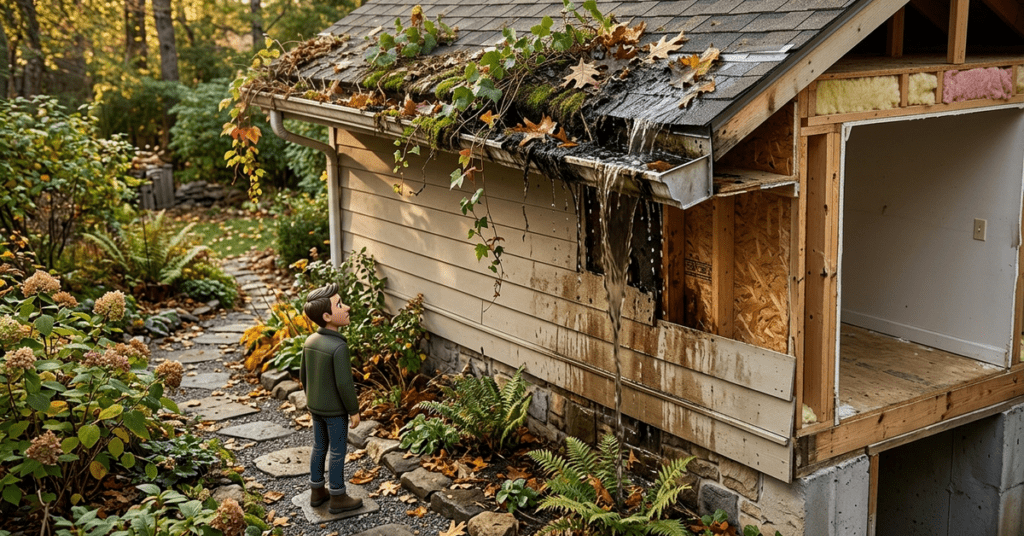
A customer once described discovering their gutters were clogged and overflowing by noticing that the mulch against their foundation had turned into a swamp. The gutters hadn’t been cleaned in a few years, pine needles had completely blocked the downspouts, and every significant rain for the past two seasons had been dumping several hundred gallons of water directly against the base of their house.
The damage assessment was not pleasant. Saturated soil against the foundation wall had led to some settling. The fascia board behind the gutter was rotted through and had to be replaced. And the crawl space had elevated moisture levels that required treatment.
All of this started as a hundred-dollar problem.
Where the Damage Actually Shows Up
Gutters fail in a pretty predictable sequence. First they clog, which usually means debris from whatever trees are nearby — pine needles in the CSRA are particularly bad, because they pack tightly and hold moisture. Then the clog creates a backup. Water has nowhere to go, so it sits in the gutter, finds the path of least resistance, and that path is usually over the edge or behind the gutter into the fascia board.
A fascia board that stays wet eventually rots. That rot spreads. The gutter itself, once the fascia behind it is compromised, starts to pull away from the house. You can usually see this from the ground as a visible gap or sag in the gutterline.
Meanwhile, any water that spills over the front edge of a full gutter falls right against the foundation. In a house with a basement this is an obvious problem. In a house with a crawl space it’s less visible but just as real. Soil that stays saturated against a foundation wall creates pressure that can cause cracks over time, and it creates the moisture conditions that wood-destroying insects love.
Landscaping takes a hit too. Plants and mulch along the foundation zone get hammered by the waterfall effect of an overflowing gutter, and the splash back from hard rain hitting saturated ground or concrete kicks water up against your siding in ways it wasn’t designed to handle.
None of this happens all at once. It accumulates over years, which is part of what makes deferred gutter maintenance such an effective way to turn a simple maintenance task into an expensive repair.
Gutter Guards: Are They Worth It
Gutter guards vary a lot in quality and effectiveness. The cheap foam inserts and the plastic screens available at hardware stores work initially and fail within a couple of years. Debris gets under or through them, they degrade in UV light, and you end up with a cleaning job that’s harder than it would have been without them.
Quality micro-mesh guards are a different category. These are professionally installed systems with fine mesh screens that block pine needles, shingle grit, and fine debris while allowing water to flow. In the CSRA, where pine trees drop needles constantly and summer storms are heavy, these are worth serious consideration. They don’t eliminate gutter maintenance entirely, but they extend the interval between cleanings substantially and prevent the catastrophic clogging scenario that causes real damage.
The honest answer on whether they’re worth the cost is: it depends on your tree situation and how much you want to think about your gutters. If you have large pines or sweet gums over your roofline, micro-mesh guards pay for themselves in reduced maintenance calls and in the damage they prevent. If your lot is relatively clear of overhanging trees, basic gutters cleaned once or twice a year do the job fine.
What to Know If You’re Replacing Gutters
Seamless gutters — the kind fabricated on-site from a continuous run of aluminum — are the standard for a reason. They don’t have joints in the runs where seams can separate and leak over time. The only seams are at corners and downspout connections, which are properly sealed. For a home in a climate that sees as much rainfall as Augusta, seamless gutters are worth the modest additional cost over sectional gutters.
Size matters too. Standard 5-inch K-style gutters handle normal rainfall fine. If you have a large roof area or are in a low spot that sees high water volume in storms, 6-inch gutters move water significantly faster and reduce the chance of overflow during heavy events.
The bottom line on gutters is this: they’re the least glamorous part of exterior maintenance, and they do a job that most homeowners don’t think about until it fails. Cleaning them twice a year — spring after tree pollen and seed drop, fall after leaves — is the minimum. Keeping an eye on the fascia condition and the sealant at seams and downspouts every few years is the rest of it. It’s not much time, and the alternative is significantly more expensive than a ladder and an afternoon.