
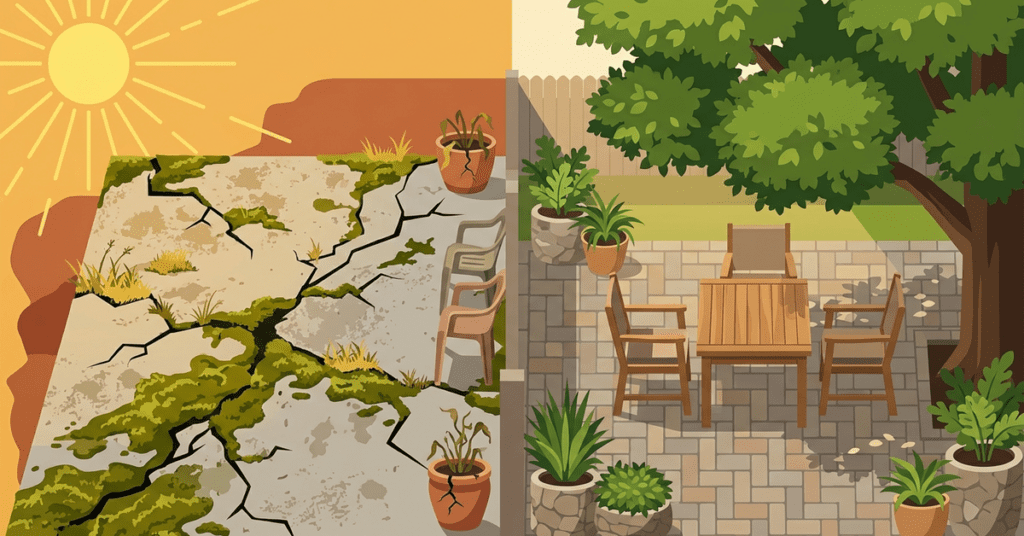
If you’re putting in a new patio and comparing poured concrete against concrete pavers, the upfront price difference tends to favor concrete. Pavers cost more per square foot for the material, and a properly prepared paver base takes more labor. On a 400-square-foot patio, you might be looking at a meaningful cost difference.
Here’s the thing: that calculation changes significantly when you factor in Augusta’s specific conditions. The combination of clay-heavy soil, significant temperature swings between summer and winter, and the kind of rainfall the CSRA sees regularly makes concrete cracking more likely here than in drier climates with more stable soil. And a cracked concrete slab is a problem that doesn’t have a clean repair.
The Cracking Problem Is a Real Problem Here
Concrete cracks. That’s not a scare tactic — it’s a material property. Concrete is strong in compression but weak in tension, so when the ground beneath it shifts (which it does, especially in clay soil that expands when wet and contracts when dry), or when temperature variation causes thermal expansion and contraction, stress cracks form.
In Augusta, both of those conditions are present year-round. Summer heat causes concrete to expand. Winter cold causes it to contract. The clay in the soil profile under much of this area swells significantly when it takes on moisture, which means the ground itself is moving under your patio through seasonal cycles.
A properly installed concrete patio with control joints can manage this reasonably well, but it can’t eliminate cracking entirely. When cracks form, the cosmetic options are limited. You can fill them, but a filled crack is visible. You can resurface the entire slab, which is an additional cost. Or you can live with it, which most homeowners do, and watch the crack gradually widen as water gets in and freeze-thaw cycles (even moderate ones) work at the edges.
Pavers Handle Ground Movement Differently
A paver patio is a flexible system. Each unit moves somewhat independently of its neighbors, which means when the ground beneath shifts, the pavers shift with it — gradually, and usually without cracking. If you have an area that settles noticeably, you can pull those specific pavers, re-level the base material, and reset them. The repaired area blends back in.
That repair scenario — pulling a few pavers, adding some base material, resetting — is an afternoon’s work. The equivalent for poured concrete is either accepting an uneven cracked section or grinding it down and patching, neither of which looks as clean.
This repairability matters more as a patio ages. A concrete patio that looks fine at year five can look rough by year fifteen if it’s seen some settling. A paver patio that’s had a few sections addressed along the way typically ages better because small problems get fixed before they become larger ones.
Heat on the Surface
Pavers also perform better in summer heat than plain concrete. A broom-finished concrete slab in full afternoon sun can get uncomfortably hot underfoot — hot enough to limit barefoot use and to make the surface radiating heat upward a factor in how the space feels. Pavers have more texture and air circulation between units, which moderates surface temperature somewhat.
This is a real comfort factor in a climate where you’re using an outdoor patio from April through October. It’s not dramatic — we’re talking degrees, not a complete solution — but it’s a legitimate difference.
What About the Cost Over Time
The pavers-versus-concrete calculation looks different when you account for a ten-to-fifteen-year window. A concrete slab that requires resurfacing or partial replacement at year eight or ten isn’t as cost-effective as its initial price suggested. Pavers that required a few occasional section resets during that same period — work that a competent contractor can do quickly and affordably — tend to come out ahead on total cost over the life of the patio.
This isn’t a guaranteed outcome. A well-prepared concrete slab can last for decades without significant problems, especially if it was poured correctly with proper control joints and base preparation. But the margin for error with concrete is narrower, and the consequences of getting it wrong are harder to correct.
For most homeowners in the CSRA who are planning a patio that will last, pavers are worth the additional upfront investment. The durability, repairability, and appearance hold up better over time in conditions that are specifically challenging for poured concrete.