
Most homeowners do not think about gutter size until something goes wrong.
Water starts pouring over the edge during a storm. Mulch washes away. The flower beds flood. The siding gets stained. A corner of the house always seems damp. Suddenly, those gutters that used to blend into the background become a very real problem.
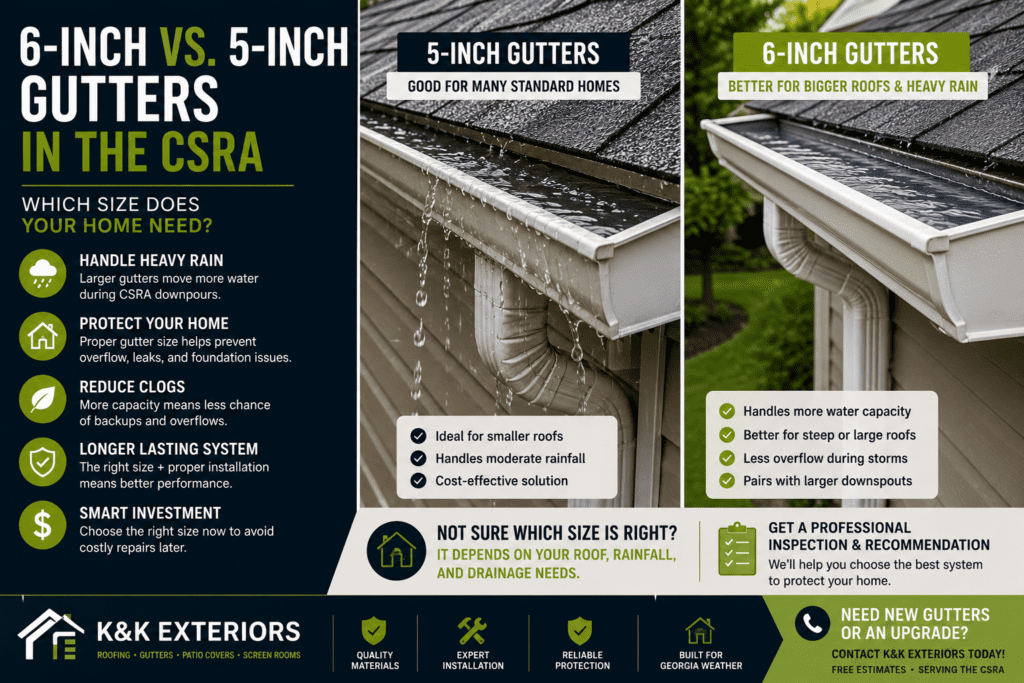
If you are comparing 6-inch vs. 5-inch gutters in the CSRA, the short answer is this: both sizes can work, but the right choice depends on your roof, rainfall, drainage needs, and how much water your gutter system has to handle.
For many homes, 5-inch gutters are standard. But in areas like Augusta and the CSRA, where heavy rain can hit fast, 6-inch gutters may offer better performance for larger roofs, steeper rooflines, and homes that have struggled with overflow.
What Is the Difference Between 5-Inch and 6-Inch Gutters?
The difference sounds small, but it can matter.
A 5-inch gutter is a common residential gutter size. It works well for many average homes, especially when the roofline is simple and the drainage system is properly installed.
A 6-inch gutter is larger. It can hold and move more water than a 5-inch gutter, which can be helpful during heavy rain. It also pairs well with larger downspouts, giving water a better path away from the home.
In simple terms:
- 5-inch gutters are common and may work well for many standard homes.
- 6-inch gutters can handle more water and may be better for larger or more demanding drainage situations.
That extra inch may not look dramatic from the ground, but during a CSRA downpour, capacity matters.
Why Gutter Size Matters in the CSRA
The CSRA gets plenty of rain, and storms can move in quickly.
When a gutter system cannot keep up, water does not politely wait its turn. It spills over the edge, runs behind the gutter, splashes against the siding, or dumps too close to the foundation.
Over time, that can contribute to:
- Fascia and soffit damage
- Siding stains
- Foundation moisture concerns
- Washed-out landscaping
- Soil erosion
- Crawl space moisture problems
- Water pooling near walkways or entryways
- Gutter sagging or separation
A properly sized gutter system helps move water away from the home before it becomes a bigger exterior problem.
When 5-Inch Gutters May Be Enough
A 5-inch gutter system may be a good fit for many homes, especially if the roof is not overly large or steep.
They can work well when:
- The home has a simple roofline
- The roof area draining into each gutter run is moderate
- The gutters are properly pitched
- Downspouts are placed correctly
- The home has not had major overflow problems
- Trees and debris are not constantly clogging the system
If your current 5-inch gutters are working well, water flows correctly, and you do not see regular overflow during storms, you may not need to size up.
But if you are replacing old gutters anyway, it may still be worth asking whether 6-inch gutters would give your home better long-term protection.
When 6-Inch Gutters Make More Sense
A 6-inch gutter system may be a better choice if your home needs to handle more roof runoff.
They may make sense when:
- Your roof is large
- Your roof has a steep pitch
- Long roof sections drain into one gutter run
- You have had overflow during heavy rain
- Water spills over the gutter edges
- Your home has a complex roofline
- Your gutters clog easily
- You want larger downspouts for better flow
- You are already planning gutter replacement
In the CSRA, 6-inch gutters can be especially helpful for homes that get hit hard during sudden storms. The larger size gives water more room to move, which can reduce overflow when the system is properly installed.
Roof Pitch Can Affect Gutter Size
A steeper roof sheds water faster.
That means rainwater can rush into the gutters quickly during a storm. If the gutter is too small or the downspouts cannot keep up, water may overshoot or overflow.
Homes with steep rooflines often benefit from larger gutters because they need more capacity during heavy rainfall.
This is one reason two homes with similar square footage may need different gutter systems. The roof shape, pitch, and drainage layout matter just as much as the size of the house.
Downspouts Matter Too
A larger gutter is only part of the equation.
If the downspouts are too small, too few, clogged, or poorly placed, water can still back up. The gutter may collect water just fine, but the system cannot move it away fast enough.
That is why 6-inch gutters are often paired with larger downspouts. The goal is to create a full drainage system that can collect water and move it away from the home efficiently.
When planning gutter installation or gutter replacement, ask about both gutter size and downspout placement.
Bigger Is Not Always Automatically Better
It is easy to assume 6-inch gutters are always the best choice because they hold more water. But that is not always true.
Some homes do not need the extra capacity. On smaller homes with simple rooflines, 5-inch gutters may perform perfectly well when installed correctly.
The right choice depends on the home.
A good gutter contractor should look at your roofline, water flow, current gutter problems, landscaping, drainage points, and existing damage before recommending a size.
You do not want to overpay for something unnecessary, but you also do not want to install a system that cannot keep up with your home’s drainage needs.
Signs Your Current Gutters May Be Too Small
Not sure if your gutters are undersized? Look for what happens during and after rain.
Your gutters may be too small or not draining properly if you notice:
- Water overflowing during storms
- Water spilling behind the gutters
- Sagging gutter sections
- Dirt trenches below the roofline
- Mulch washing away
- Stains on siding or brick
- Water pooling near the foundation
- Downspouts that gush or back up
- Frequent clogs
- Gutters pulling away from the fascia
These signs do not always mean gutter size is the only issue. The system may also be clogged, damaged, improperly pitched, or missing enough downspouts. But they are signs that your gutter system needs attention.
What About Gutter Guards?
Gutter guards can help protect either 5-inch or 6-inch gutters from leaves, pine needles, and debris.
In the CSRA, that can be especially helpful if your home is surrounded by trees. Pine needles, oak leaves, and roof grit can clog gutters quickly, especially during storm season.
However, gutter guards do not fix an undersized or poorly installed system. If your gutters are too small, sagging, leaking, or not pitched correctly, guards alone will not solve the problem.
The best approach is to make sure the gutter system is properly sized and installed first, then consider guards as added protection.
Gutter Replacement Is the Best Time to Upgrade Size
If your gutters are old, damaged, or constantly overflowing, replacement may be a good time to consider moving from 5-inch to 6-inch gutters.
Upgrading during replacement can help avoid future drainage problems, especially if your current system has struggled during heavy rain.
A replacement project also allows the contractor to review the full setup, including:
- Gutter size
- Downspout size
- Downspout placement
- Pitch and slope
- Fascia condition
- Gutter guards
- Drainage away from the home
This gives you a better chance of getting a system that actually fits your home’s needs.
Which Gutter Size Should You Choose?
For many standard homes, 5-inch gutters can still be a solid choice.
But if your CSRA home has a large roof, steep pitch, long gutter runs, heavy runoff, or overflow issues, 6-inch gutters may be worth considering.
A simple way to think about it is this:
If your current gutters work well and your roofline is simple, 5-inch gutters may be enough. If your gutters struggle during storms or your home has more demanding drainage needs, 6-inch gutters may provide better protection.
The smartest answer comes from looking at the actual home, not guessing from the ground.
Need Help Choosing Between 6-Inch and 5-Inch Gutters?
Need help deciding which gutter size is right for your home? K&K Exteriors can inspect your current drainage setup and help you compare 6-inch vs. 5-inch gutters in the CSRA for your roofline, rain exposure, and long-term home protection needs.