
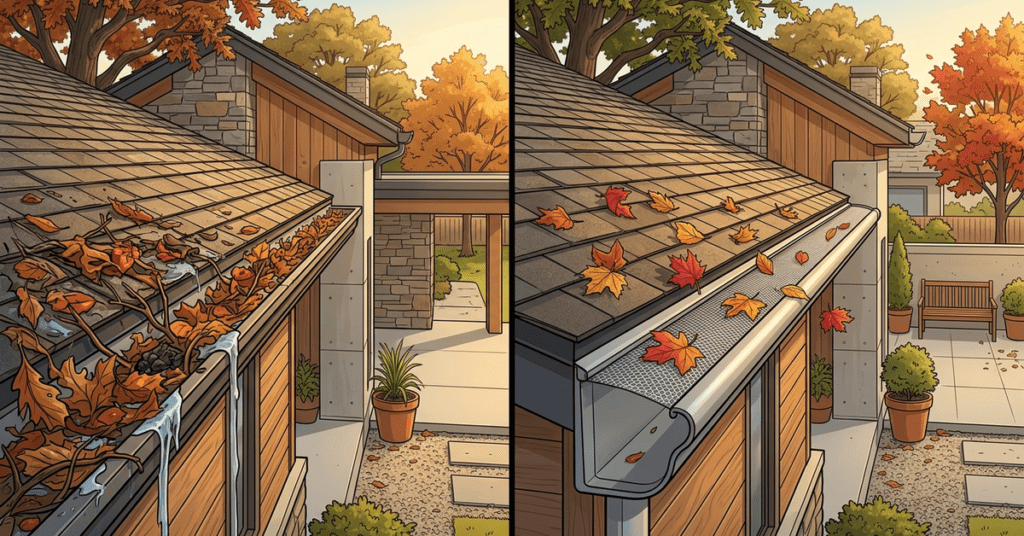
The honest answer is: it depends entirely on which kind you’re talking about. Gutter guards are a product category that spans from five-dollar foam inserts that fail within a season to professionally installed micro-mesh systems that meaningfully reduce gutter maintenance for years. Lumping them together and asking whether they “work” is a little like asking whether cars are reliable.
Here’s what actually distinguishes the options.
The Ones That Don’t Really Work
The cheap foam inserts and the plastic snap-on screens you find at hardware stores have a straightforward failure mode. They block large debris initially, but fine material — shingle grit, pine needles, small seeds — gets into and through them. Organic matter accumulates on top of and inside the guard, holds moisture, and eventually the guard itself becomes a debris trap. You end up with a clogged gutter that’s harder to clean than it would have been without the guard, because now you have to remove the inserts first.
These products aren’t designed for the CSRA’s combination of pine trees, high pollen loads, and summer storms. They degrade in UV, they buckle in heat, and they give you maybe two years of reduced maintenance before they create a new problem.
Reverse-curve guards — the type where water is supposed to cling to a curved surface and flow into a slot while debris falls off — work reasonably well for large leaves but struggle with the fine debris that’s actually the bigger problem in this region. Pine needles slide right into the slot along with the water.
The Ones That Actually Deliver
Micro-mesh guards are a different category. The mesh is fine enough to block pine needles, shingle granules, and the small seed pods that fall in spring. Water flows through the mesh and into the gutter. The guard sits under the first course of shingles and attaches to the gutter fascia, so it’s secure and not going anywhere.
The key word is micro-mesh — the openings need to be small enough to block fine debris, which means something in the 50-micron range or smaller. Products with larger openings let fine material through and eventually have the same buildup problems as cheaper guards.
These aren’t a maintenance-free solution. Fine debris does accumulate on the surface of the mesh over time, and an annual rinse with a garden hose from the ground or a quick inspection keeps them performing well. What they eliminate is the twice-yearly full cleaning and the risk of catastrophic clogging during a heavy storm. For most homeowners, that’s the actual value proposition.
Whether They’re Worth It for Your Home
The math on micro-mesh guards depends primarily on your tree situation. If you have large pines, sweet gums, or oaks with overhanging canopy over your roofline, you’re dealing with significant debris volume every season, and quality guards pay for themselves over a few years in reduced maintenance costs and in the damage they prevent from overflow events.
If your roof is relatively clear of overhanging trees, basic gutters cleaned once in spring and once in fall do the job without the added expense of guards. The guards aren’t going to make a dramatic difference on a lot with minimal tree coverage.
Augusta’s storm season is the other factor. When you get two inches of rain in forty minutes, gutters that are even partially clogged overflow. That overflow goes somewhere, and where it goes is usually not somewhere you want it. Micro-mesh guards reduce the chance of that scenario meaningfully, which for homes with heavy tree coverage is a real benefit beyond just the convenience factor.
The short version: skip the hardware store options entirely. If you want gutter guards that actually perform, it’s micro-mesh professionally installed, or it’s regular maintenance without guards. Either approach works. The middle ground mostly doesn’t.