
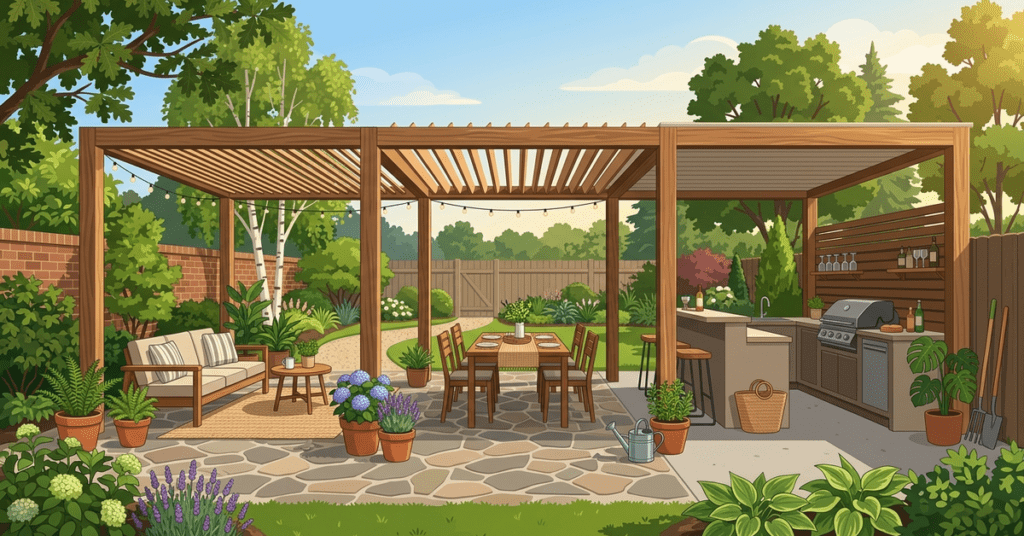
When most people picture a pergola, they picture open lattice — parallel rafters with gaps between them, casting that signature striped shadow pattern across a patio. That’s the classic look, and it works well in a lot of situations. But it’s not the only option, and depending on how you plan to use the space, it might not be the best one for your yard.
The roof structure you choose changes how much shade you get, whether you can use the space in rain, and how the pergola feels to sit under. In Augusta, where summer sun is intense and afternoon thunderstorms are a regular occurrence from May through September, those factors matter more than they might in a milder climate.
Open Lattice: The Classic and Its Limits
Open lattice is what most pergolas are built with by default. The rafters are spaced several inches apart, letting direct sunlight filter through in a pattern that shifts across the day. It’s visually light, it doesn’t obstruct the sky, and it creates a pleasant dappled shade effect in the morning and late afternoon.
The honest limitation in this climate is that it doesn’t do enough in peak summer. Between about 11am and 3pm on a July day in Augusta, the sun is high enough that the gaps between rafters let in considerable direct light. The shade a standard open-lattice pergola provides at midday is partial at best. For morning coffee or evening use, it’s fine. For a summer lunch outside, less so.
You can improve this by adding shade fabric, climbing plants trained over the rafters, or a retractable canopy. These are reasonable solutions and many homeowners use them. They’re also add-ons that require some maintenance — fabric fades and needs replacing, canopies need to be retracted in high wind, plants require training and seasonal attention.
Louvered Roofs: The Most Flexible Option
A louvered pergola roof uses motorized or manually adjustable slats that rotate to control light and airflow. Open them up and you have the open-lattice effect with full airflow. Close them and you have a solid, waterproof roof. Angle them and you control how much direct sun comes through while keeping air moving.
This is the most functional option for a climate like Augusta’s. You can close the louvers during a rainstorm and keep using the space. You can angle them in summer to block overhead sun while keeping a breeze moving through. In spring and fall when the weather is perfect, you open them fully and get the open-air experience.
The cost is the main consideration. Louvered systems — particularly motorized ones with weather sensors that close automatically when it rains — are the premium end of pergola pricing. The components are mechanically more complex and require periodic maintenance to keep operating properly. For homeowners who will genuinely use the feature and want year-round outdoor living, the investment tends to pay off. For someone who mainly wants a pretty structure and will use it seasonally, it’s probably more than necessary.
Solid Covered Roofs: Shade and Rain Protection
A solid pergola cover — typically metal roofing panels, polycarbonate sheeting, or an extension of the home’s existing roof material — gives you full rain protection and maximum shade. This is functionally closer to a covered porch than a traditional pergola, and the distinction matters for how you use and furnish the space.
Under a solid cover, you can put out furniture and accessories you wouldn’t otherwise leave outdoors. You can use the space in rain without getting wet. And the shade on a hot afternoon is complete rather than partial.
The tradeoff is that a solid roof changes the feel of the space. You’re under a roof, not under an open sky. The airiness that makes a pergola feel different from an indoor room is diminished. For some homeowners that’s fine — they want a functional outdoor room more than an airy garden structure. For others, it defeats part of the point.
Solid covers are also subject to more permitting scrutiny than open-lattice pergolas in many jurisdictions, since they’re closer to a permanent structure. Worth confirming locally before you commit.
What Makes Sense in Augusta
For most homeowners in the CSRA who want a pergola they’ll actually use through the summer, the open-lattice-only build requires some kind of shade supplement to be fully comfortable at midday. If you’re on a budget and comfortable with a retractable shade sail or fabric canopy as an add-on, that works fine. If you want something built-in and functional without thinking about it, louvered or solid-covered options are worth pricing out before you default to standard lattice.
The climate here makes shade genuinely important — not a nice-to-have but a factor in whether the space gets used. It’s worth having that conversation before you build rather than after.