Every contractor pitch and home improvement article eventually makes the same move: they tell you the project will add value to your home. Sometimes that’s accurate. Sometimes it’s a stretch. And sometimes people spend money on outdoor improvements that genuinely improve their life but don’t move the needle on appraisal value much at all — which is fine, as long as you go in knowing that.
Here’s an honest breakdown of what outdoor projects actually do and don’t do for home value in the CSRA.
What the Data Generally Says
Real estate appraisers and agents talk about “value in use” versus “value in sale.” A $40,000 outdoor kitchen might bring tremendous value in use for a family that entertains regularly for ten years. At sale, that same outdoor kitchen might add a fraction of its cost to the sale price, because buyers don’t universally value it the same way you did.
The outdoor projects that consistently appraise well share a few characteristics. They’re well-maintained. They’re functional rather than highly personal. They improve the livability of the home in ways that most buyers understand and want. And they’re appropriate in scope for the neighborhood — a very expensive outdoor build in a neighborhood of modest homes doesn’t appraise to its full value because comparable sales don’t support it.
Projects That Tend to Add Solid Value
A screened porch in this region is on the reliable side of the ledger. Buyers in the South understand what a screened porch offers, and homes with them sell faster and for more than comparable homes without them. The value isn’t always dollar-for-dollar with the installation cost, but it’s typically meaningful. The key is that it has to be done well — a screen porch that’s sagging or has weathered wood or questionable framing actually hurts value.
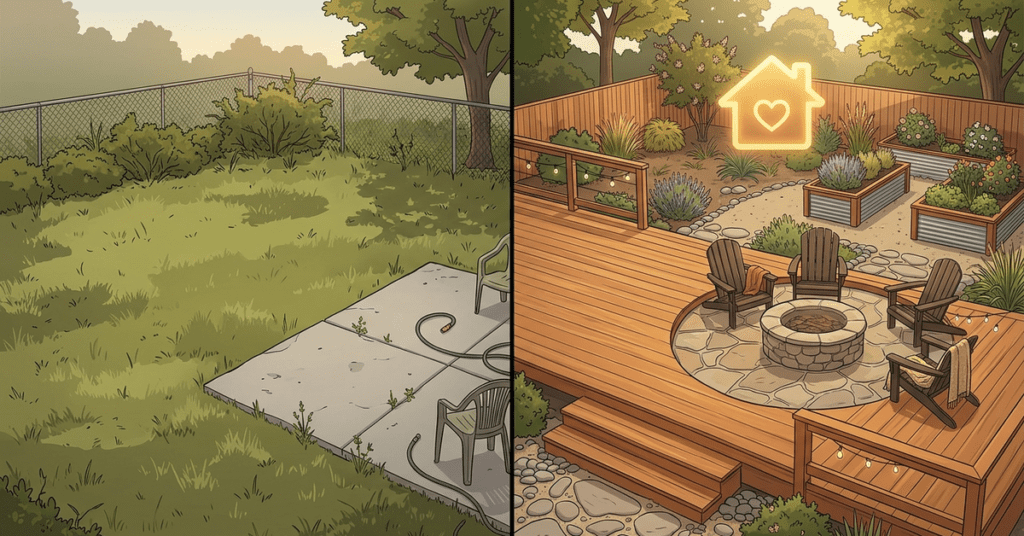
A well-built paver patio adds value in a similar way. It improves curb appeal, it creates clearly defined outdoor living space, and it reads as a quality improvement rather than a cosmetic one. A stained or cracked concrete slab does neither of those things.
Gutters and gutter maintenance are in a different category — they don’t add value so much as protect the value you have. A home inspection that flags failing or clogged gutters, deteriorating fascia, or water infiltration at the foundation affects buyer confidence and negotiation in ways that cost more to recover from than the gutter maintenance would have. Think of functional gutters as a floor, not a ceiling.
Where the ROI Math Gets Complicated
Pergolas are genuinely valuable to people who use them, and they photograph well and show well. But they occupy a middle zone in appraisal terms — they add to livability and visual appeal without necessarily showing up clearly in the comparable sale data that supports a formal appraisal. Buyers love them, but they’re more difficult to quantify precisely.
Fire pits, outdoor kitchens, and elaborate entertainment structures are the personal-preference category. Some buyers will be excited about them. Others will not factor them into their offer or will see them as maintenance concerns. These are things you build because they improve your life, not primarily because they’ll recoup their cost at sale.
The Real Calculation
The most useful way to think about any outdoor project is to separate two questions: will you actually use this and enjoy it for as long as you live here, and what will it do for your home’s value? Those are different questions with different answers, and you should be honest about both before committing.
A screened porch that adds $15,000 to your home’s value and that you use four evenings a week for the next ten years is a very good investment by any measure. An outdoor kitchen that adds $8,000 to your home’s value and that you use regularly for twelve years is also a good investment, even if the ROI math doesn’t pencil out perfectly.
The mistake is spending heavily on outdoor improvements primarily for the resale value and not actually using them in the meantime. That’s the scenario where the math works out the worst.
The better framework: think about what would genuinely improve how you live in your house, build it well so it holds its condition, and maintain it. That approach consistently delivers both quality of life and reasonable value retention — and it’s a better guide than chasing ROI projections that are never as precise as the pitch makes them sound.