
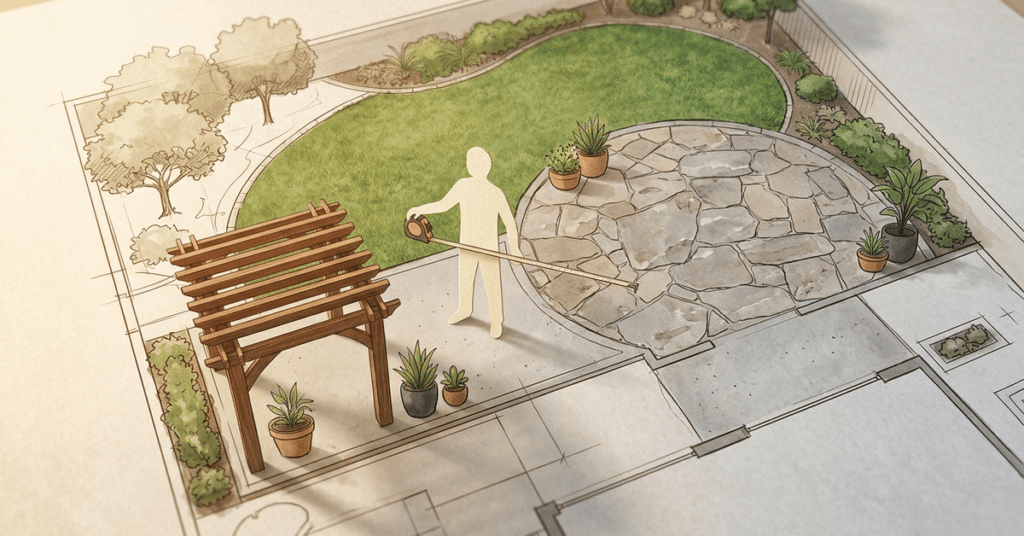
The most common sizing mistake people make with pergolas is going too small. You see the dimensions on paper, picture a 12-by-12-foot square in your mind, and it sounds like plenty. Then you try to fit a dining table for six, a few chairs, and some breathing room around the edges, and you realize you’re working with a footprint that’s more suited to a breakfast table for two.
The reason this happens is that people measure for the furniture and forget to account for circulation. You need to be able to pull a chair out without backing into a post. You need to walk around the table without squeezing. A dining set that fits in a 9-by-9-foot space in your dining room takes a 12-by-16-foot pergola to feel comfortable outside, because the posts are in there and outdoor furniture tends to be proportioned larger than indoor pieces.
Starting With How You Actually Plan to Use It
Before thinking about dimensions, it helps to be specific about what you want to do under the pergola. That sounds obvious, but it’s worth doing deliberately.
If it’s primarily for dining, the table size is your anchor point. A 6-person table is typically 36 by 72 inches minimum. Add four feet of circulation around the perimeter — two feet on each side — and you need at least a 9-by-14-foot clear space just for that use, plus whatever the posts take up at the corners. Work backward from the posts-in to posts-out measurement to get your actual footprint.
If it’s a conversation area with lounge furniture — a sofa, chairs, a coffee table — the math changes. A typical outdoor sofa is about 7 feet wide. Two chairs and a coffee table need another 8 feet of width. You need at least 12 feet across and more than that in depth to keep the layout from feeling cramped.
If you want to do both — have a dining end and a seating end — that’s a legitimate approach that makes a pergola feel more like a real outdoor room, and it typically puts you in the range of 16 to 20 feet on your longer dimension.
What Ceiling Height Does to the Feel
The height of a pergola changes the experience more than people expect. A standard 8-foot ceiling height — common in residential construction — feels low under a pergola, particularly on a warm afternoon. The air circulation suffers, and the structure can feel more like a cage than a retreat.
Most outdoor pergolas are built at 9 to 10 feet of interior height, and that extra foot or two makes a meaningful difference. It improves airflow, it lets ceiling fans if you’re adding them run at a reasonable distance from your head, and it makes the overall structure feel less imposing and more airy.
For attached pergolas that connect to the house, the roofline constrains your options. For freestanding pergolas, you have more flexibility, and it’s generally worth erring on the side of taller.
Fitting the Pergola to the Yard
The other sizing consideration is proportionality to the overall outdoor space. A pergola that takes up 80 percent of a small backyard will dominate everything and make the yard feel smaller. One that’s undersized in a large yard looks like it landed from somewhere else.
A rough guideline that works reasonably well: the pergola should cover no more than about a third of your usable outdoor space, leaving open lawn or garden area around it. This preserves the sense of the yard as a whole while giving the pergola enough visual weight to feel intentional.
Corner placement in a larger yard tends to work better than center placement, because it creates a destination — you walk to the pergola — rather than dividing the space in half. Off the back door, attached to the house, works for the same reason: it’s an extension of the interior, not a thing sitting in the middle of the yard.
Getting a Measurement Before You Commit
The easiest way to test sizing before anything is built is to mark out the footprint with rope or garden hose and live with it for a few days. Put your existing furniture inside the outline and see how it feels. Walk around it. Sit in the chairs. You’ll know immediately if it’s right or if you need to rethink the dimensions.
This is a fifteen-minute exercise that prevents a pretty significant mistake, and almost nobody does it. The people who do are consistently glad they did.