
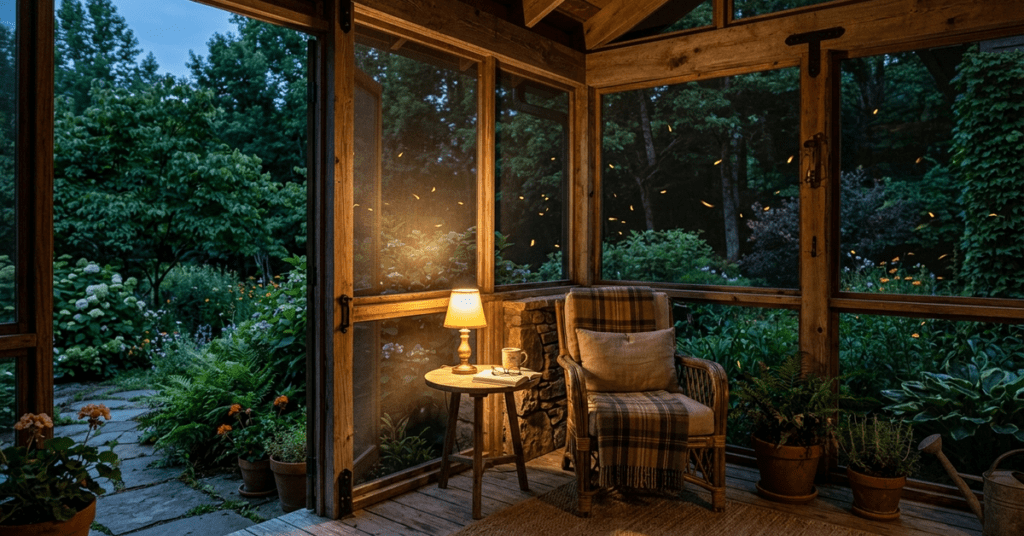
August in Augusta is not subtle. You step outside and the air has weight to it. Mosquitoes treat exposed skin as a personal invitation. Spending time on a regular open porch between late May and early October is something most people give up on after about ten minutes.
The screened-in porch is the answer to this that people in the South figured out a long time ago, and it holds up. You get the feel of being outside — the light, the breeze, the sounds of the yard — without the bugs and with a meaningful reduction in the heat that direct sun causes. For a lot of homeowners in the CSRA, it becomes the room they use more than any other during the nine months the weather cooperates.
What Actually Changes When You Screen It In
An open porch is nice in theory. In practice, if it’s not screened, you’re spending maybe four months of the year using it comfortably. A screened porch extends that to nine or ten months. That’s the part of the calculation that surprises people who haven’t had one before.
The bugs alone are worth it. Augusta sits in a part of the country with a serious mosquito season that runs from spring into fall, and that’s before you factor in gnats, no-see-ums, and the rest of the warm-weather insect situation. Screening doesn’t eliminate all of it, but it creates a genuinely bug-free environment that an open porch can’t offer regardless of how many citronella candles you light.
The heat management is real too. A screened porch in partial shade reads several degrees cooler than a sunny open patio because the screening itself blocks some solar radiation and there’s no direct sun hitting the floor and radiating back up at you. It’s not air conditioning, but it’s comfortable in a way that an exposed surface isn’t.
The other thing that changes is how you use the space. When there’s a comfortable, defined room right off the back of your house that’s usable most of the year, it becomes a natural extension of your living space. Dinner outside on a Tuesday is no longer a production — it’s just what you do.
The Structure Matters More Than the Screening
Screen is screen. What makes or breaks a screened porch is the structure it’s attached to, how it’s built, and whether it was done with the right materials for this climate.
Pressure-treated lumber is the standard for the frame in this region, and that’s appropriate. Augusta’s humidity is real, and untreated wood in contact with moisture — particularly at the base of posts — degrades faster than people expect. The posts should be set properly, with appropriate footings, not just sitting on deck blocks, or you’ll have a settling and alignment problem within a few years.
The roofline matters a lot. A screened room that ties into your existing roof properly looks like part of the house. One that doesn’t will always read as an add-on. Getting this right requires some planning and coordination with your roofline and existing drainage, and it’s worth doing correctly from the start.
Screen choice is worth a conversation. Standard fiberglass screen is fine. But solar screen fabric, which is denser and cuts more light and heat, is worth considering for south- or west-facing porches that get afternoon sun. It costs more but meaningfully changes the comfort level in a hot climate.
What It Does for Your Home’s Value
Screened porches are on the short list of outdoor additions that reliably add value to homes in the South. Buyers in this market understand immediately what they’re getting — functional outdoor space that’s usable most of the year — and they price it accordingly.
But more than resale value, which is always a secondary consideration when you’re thinking about improvements you’ll actually live with, is what a screened porch does for daily quality of life. If you’re in a house for fifteen more years and you spend three evenings a week on a porch you love, you’ve added something that no other home improvement would give you.
The upfront cost is real. A well-built screened porch is a meaningful investment. But the cost-per-use math tends to work out well for families who spend time at home and value outdoor living, which in this region is most people.
If your house has any reasonable outdoor space and no screened porch, it’s worth at least getting a conversation going about what it would take.