
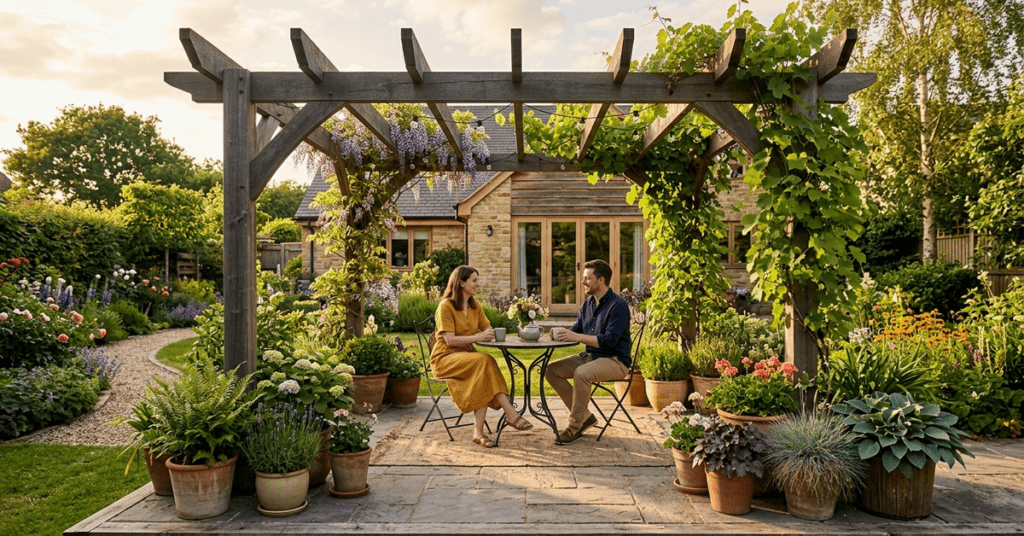
Most backyards sit empty nine months out of the year. Not because people don’t like being outside, but because there’s no comfortable reason to be there. A patio slab with no shade is usable for about three weeks in spring before Augusta turns it into a skillet. A pergola changes that math.
It’s not a complicated structure. Posts, beams, and open-lattice rafters — enough to define a space and cut the direct sun without closing you in. The difference in temperature under a pergola versus a bare patio can be eight to twelve degrees on a hot afternoon, which in this part of Georgia is the difference between staying inside and actually using your yard.
The other thing a pergola does is give your outdoor space a sense of purpose. Before one, the area behind your house is just yard. After, it’s a place where things happen — dinner, coffee in the morning, the kids doing homework outside, a beer at the end of the day. The structure itself signals that this is a room, even without walls.
Attached or Freestanding: Which One Makes Sense
An attached pergola connects directly to your house, typically off the back door or a sliding glass door. This works well if you want a seamless transition from inside to outside — you step out of the kitchen and you’re immediately in a shaded, defined outdoor dining space. It’s also generally more cost-effective to build, since it ties into the existing structure of your home.
The downside is placement. You’re locked into building it wherever your house allows, and depending on your roofline, you may not get a great orientation for shade.
A freestanding pergola gives you more flexibility. You can put it at the edge of a pool, in a corner of the yard that gets afternoon shade naturally, or anywhere the terrain makes sense. It functions more like a destination — a reason to walk out into the yard rather than just step outside. The tradeoff is cost, since it needs its own footings and structural support.
Neither option is the obvious right answer. It depends on your lot, what you’re trying to accomplish, and how you actually use your outdoor space now.
Materials Matter More Than People Think
Cedar and pressure-treated pine are the most common wood choices in this region, and both are reasonable. Cedar is naturally resistant to insects and rot, holds up well in humid climates, and looks good without being painted. Pressure-treated pine is more affordable and also durable, though it needs to be properly dried and finished before paint or stain goes on or you’ll have peeling problems within a couple of years.
Vinyl pergolas require almost no maintenance — no staining, no painting, no worrying about moisture damage — but they have a plasticky look that doesn’t appeal to everyone. Aluminum is another low-maintenance option that tends to look cleaner and more architectural.
If you’re drawn to wood but don’t want the upkeep, a cedar pergola with a good stain and a commitment to recoating every few years is genuinely manageable. Most homeowners in the CSRA do this with their decks already.
The Value Side of the Equation
A well-built pergola adds real value to a home in Augusta. Buyers increasingly look for usable outdoor space, and a pergola with a finished patio under it reads as an outdoor room rather than just a concrete slab. Real estate agents in the area consistently cite outdoor living features as strong selling points, particularly anything that makes the backyard feel larger and more livable.
More than that, though, is the value you get while you’re living there. If you spend your evenings inside because your backyard is too hot and exposed, and a pergola changes that, you’ve added a room to your house that you use. That’s not a small thing.
The practical honest thing about pergolas is that they’re not complicated to build well, but they’re easy to build badly. The posts need to be properly anchored, the beams need to be correctly sized for the span, and the whole thing needs to be level or it’ll look off for as long as you own it. That’s not a reason to avoid them — it’s a reason to work with someone who has built enough of them to know what they’re doing.
If you’re on the fence, the easiest thing is to spend a weekend paying attention to how you actually use your backyard versus how you’d like to. The gap between those two things is often exactly the problem a pergola solves.