
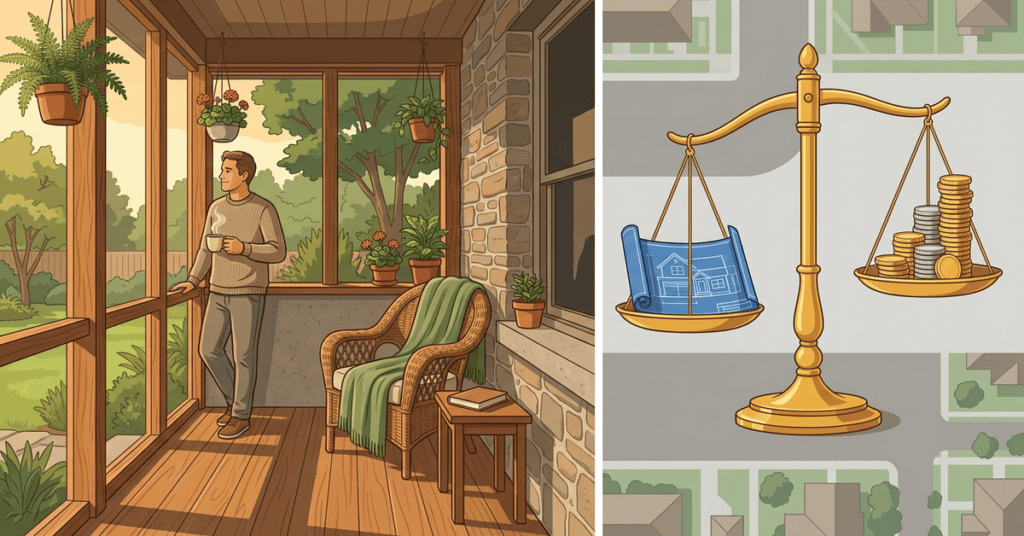
A homeowner in Evans told us she’d added up every renovation project on her house and expected her appraisal to reflect roughly what she’d spent. It didn’t, not for the screened porch anyway. The kitchen remodel showed up almost dollar for dollar. The porch barely moved the number. She wasn’t wrong to expect a return. She was just expecting the wrong kind of return from the wrong part of the process.
This trips up a lot of homeowners, and it comes down to a distinction that almost never gets explained clearly: an appraisal and a buyer’s asking price aren’t measuring the same thing, and a screened porch performs very differently on each one.
What an Appraiser Is Actually Measuring
An appraisal is built around comparable sales, meaning recently sold homes in your area with similar square footage, bed and bath counts, and features. Appraisers work from fairly standardized cost and value tables, and outdoor living additions like screened porches often get valued conservatively compared to what they actually cost to build, because comparable data for “house with screened porch” versus “identical house without one” is thin and inconsistent from one neighborhood to the next.
There’s also a structural quirk here: depending on how a porch is built and whether it’s conditioned space, an appraiser may or may not count its square footage as part of the home’s living area at all. A screen room that isn’t heated and cooled typically gets valued as an amenity rather than added living space, which caps how much it can move an appraisal regardless of build quality.
What a Buyer Is Actually Responding To
Buyers don’t appraise a house room by room with a cost table. They walk through it and react to what it feels like to live there. This is where a screened porch does real work that an appraisal doesn’t capture well.
Real estate agents in the CSRA consistently point to outdoor living space as one of the features that gets mentioned unprompted during showings, especially for buyers relocating from areas with shorter outdoor seasons who are genuinely excited about a region where a porch is usable most of the year. That reaction shows up in two places an appraisal doesn’t measure directly: how fast the house sells, and how buyers respond in a multiple-offer situation where “the porch” becomes the tiebreaker between two similar houses.
Why This Isn’t Really a Contradiction
Appraised value protects a lender’s exposure on a loan. It’s deliberately conservative and backward-looking, based on what already sold. Buyer perception is forward-looking and emotional, based on what someone imagines their life looking like in the house. A screened porch can underperform on the first measure and overperform on the second at the same time, and both things can be true about the exact same structure.
If you’re building a porch primarily to fund a future renovation loan against your home’s equity, the appraisal number is what matters, and you should go in with realistic expectations about how much a porch alone will move that figure. If you’re building it because you’re planning to sell in the next several years and want the house to show well and move faster, the buyer-reaction side of this is the one actually working in your favor, and it’s harder to put a clean dollar figure on but very real in how CSRA agents talk about these listings.
What Actually Protects Your Investment Either Way
Regardless of which side of this you care about more, a few things consistently affect how a porch performs on both fronts. Quality of construction matters more than square footage. A well-built, properly integrated porch that looks like it belongs to the house reads as an asset on a walkthrough and holds up better in an appraiser’s overall condition assessment than a bolted-on addition that looks like an afterthought. Matching materials and rooflines to the existing house also matters more than people expect. A porch that looks like it was always part of the house tends to get valued, informally and formally, more generously than one that reads as a later add-on.
If you’re weighing a screened porch against other projects specifically for resale, it helps to think about which of these two audiences you’re actually building for. They’re not the same conversation, and knowing which one you’re having changes what “worth it” actually means for your project.