
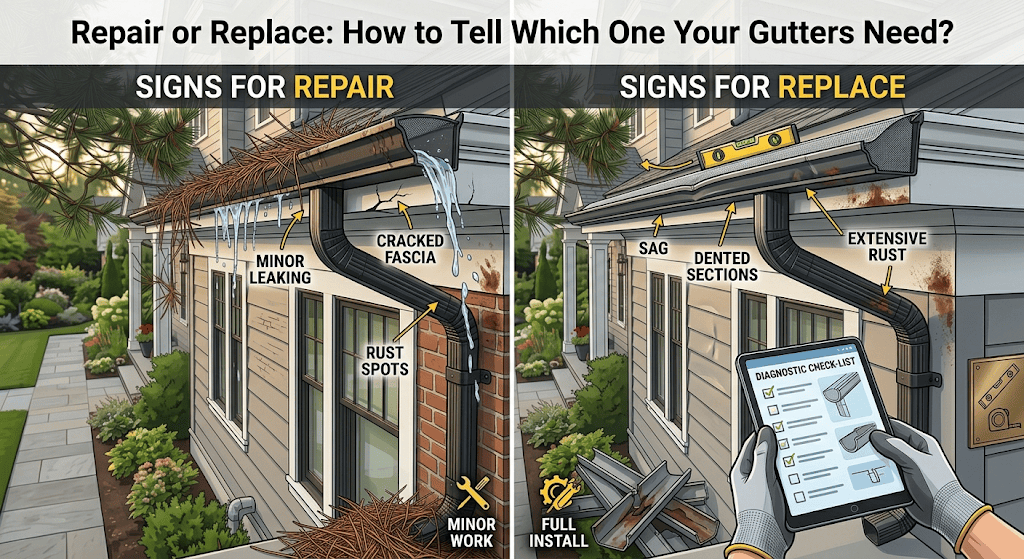
One visible drip will make an entire gutter system feel finished. Water coming off a seam onto the front steps every time it rains is impossible to ignore, and it is a common reason people start pricing a full replacement over a single joint that could be cleaned and resealed in an afternoon.
It runs the other direction just as often. A system hanging on loose spikes with three weeping seams gets patched, then patched again the following spring, and the money spent chasing it over a few years would have replaced it outright. The useful distinction is not how old the gutters are. It is which part of them has failed.
What Is Honestly a Repair
Seams and corners are repairs. A miter that has opened up gets cleaned back to bare metal and resealed, and if it is done properly it holds for years. Caulk squeezed over a dirty joint does not, which is why so many people believe corner leaks never really get fixed.
Sagging is usually a repair. A section pulling away from the fascia normally means hangers have loosened or there were never enough of them. Adding hangers and resetting the pitch is a short job, assuming the fascia board behind it is still sound.
Too few downspouts is a repair. If one run consistently overflows in heavy rain and it is clean, the answer is frequently adding an outlet and a downspout rather than replacing anything.
A single damaged length is a repair. A limb comes down, a ladder dents a run, one section gets crushed. That section gets replaced and matched, and on aluminum that is more than a decade old the color will be close but not perfect, which is worth knowing before you decide. Most of what we handle as gutter repair falls into one of those four buckets.
What Pushes It to Replacement
Spikes throughout the house is the clearest sign. If your gutters are held up by nail heads spaced every few feet and several have backed out, you are going to keep chasing them. Converting to hidden hangers on a system that old is usually within a few hundred dollars of just replacing it.
Multiple failed seams is the next one. Sectional gutter has a joint every ten feet, and when two or three start weeping, the rest are the same age and the same sealant. Fixing them one at a time is a subscription, and this is the point where gutter replacement stops being the expensive option and starts being the cheaper one.
Undersized for the roof is a replacement, not a repair. No amount of sealing fixes a gutter that cannot carry what the roof sends it. If the overflow happens in the same places every storm with the gutter perfectly clean, it is a capacity problem, and the fix is a larger profile run as a seamless installation.
Fascia rot changes the conversation entirely. Hangers screw into the fascia board, and if that board is soft, nothing you hang on it will stay. Soft fascia also tends to mean water has been getting behind the gutter for a while, and the damage rarely stops at the board. At that point the gutters have to come down anyway to repair the wood, and it is worth having someone look at the surrounding trim and siding while everything is open.
Finally, age plus appearance. Aluminum that has gone chalky and pitted is at the end of its coating even if it is not leaking yet, and a house getting new paint or new siding is the right moment to deal with it.
One piece of sequencing that saves people money: if a roof replacement is coming in the next year or two, coordinate. The drip edge is installed with the roof and it determines whether water lands in the gutter or behind it. Doing gutters first and roofing second means somebody is taking your new gutters down, or working around them badly.
The short version is that leaks, sags, and capacity are usually fixable, and fasteners, seams, and rot usually are not. Anyone quoting you a full replacement should be able to point at which of those they are looking at.